Restoration
How do we restore an interconnected forest?
One of the most important actions we can take is to protect the forest we already have. Still, we also need to create new, functioning forests to restore what has been lost.
Restoring forests will make the ecosystems more resilient and rebuild some of the severely degraded ecosystem functions. Two common intentional restoration strategies include
- Active restoration: directly seeding and planting trees.
- Passive restoration: allowing natural regeneration through e.g., protective fencing and removing invasive species.
Inspiringly, the restoration of the Atlantic Forest has become an incredible collective effort. Hundreds of organizations spanning from planting trees to reintroducing locally extinct species. In this article, I will give an overview of some of the amazing Atlantic Forest initiatives.
Tree Planting Efforts
The Trinational Atlantic Forest Pact
The Trinational Atlantic Forest Pact is an official World Restoration Flagship under the UN Decade on Ecosystem Restoration (2021-2030).
The pact represents an incredible collaborative effort to restore 1 million hectares by 2030, uniting 360 institutions across Argentina, Brazil, and Paraguay. Encouragingly, more than 700,000 hectares have already been restored.
PACTO
The Pact for the Restoration of the Atlantic Forest (PACTO) provides numerical evidence that intentional restorations can tip the scales.
Studies show that PACTO restoration areas increased net forest recovery by 10-20 percentage points compared to untreated areas. The initiative has facilitated the restoration of over 113,000 hectares.
Re.Green
Re.Green was awarded the 2025 Earthshot prize because of their use of AI and satellite technology to optimize restoration at scale.
They partnered with Microsoft to develop native species restoration models using machine learning and have committed to planting over 10 million native seedlings over 15 years.
Indigenous Stewardship
Moreover, indigenous peoples and local communities are essential leaders and partners of Atlantic Forest restoration. Studies show how Indigenous lands in the Atlantic Forest often experience less deforestation and more reforestation.
The Intergovernmental Commitment on Land Tenure endorsed at COP30 aims to protect 160 million hectares of land belonging to Indigenous Peoples, traditional communities, and Afro-descendant groups in tropical forest countries, with USD 1.8 billion pledged from 39 funding organizations to support tenure rights.
Rewilding
Refauna
When I first thought about forest restoration, I pictured only planting trees. But I learned that without animals, a forest cannot function. I learned this from Luísa Genes, Scientific Director of Refauna and a Stanford PhD candidate in biology: “A lot of restoration work is focused on restoring the forest, but not necessarily on incorporating the animals. Almost 90% of the trees in the Atlantic Forest rely on animals for seed dispersal. So if there are no animals, they’re not able to grow into new plants.”
Consequently, the majority of tree species in the Atlantic Forest rely on animals for seed dispersal. Refauna (https://refauna.org.br/) is a Brazilian non-profit organisation dedicated to restoring ecological interactions in de-faunated areas of the Atlantic Forest by reintroducing native species that have disappeared from these ecosystems. They started their work in Tijuca National Park in Rio de Janeiro back in 2010. Since then, they have been developing methods to reintroduce locally extinct species back into the wild. Refauna has successfully released and reintegrated agoutis, howler monkeys and yellow-footed tortoises into the local ecosystem.
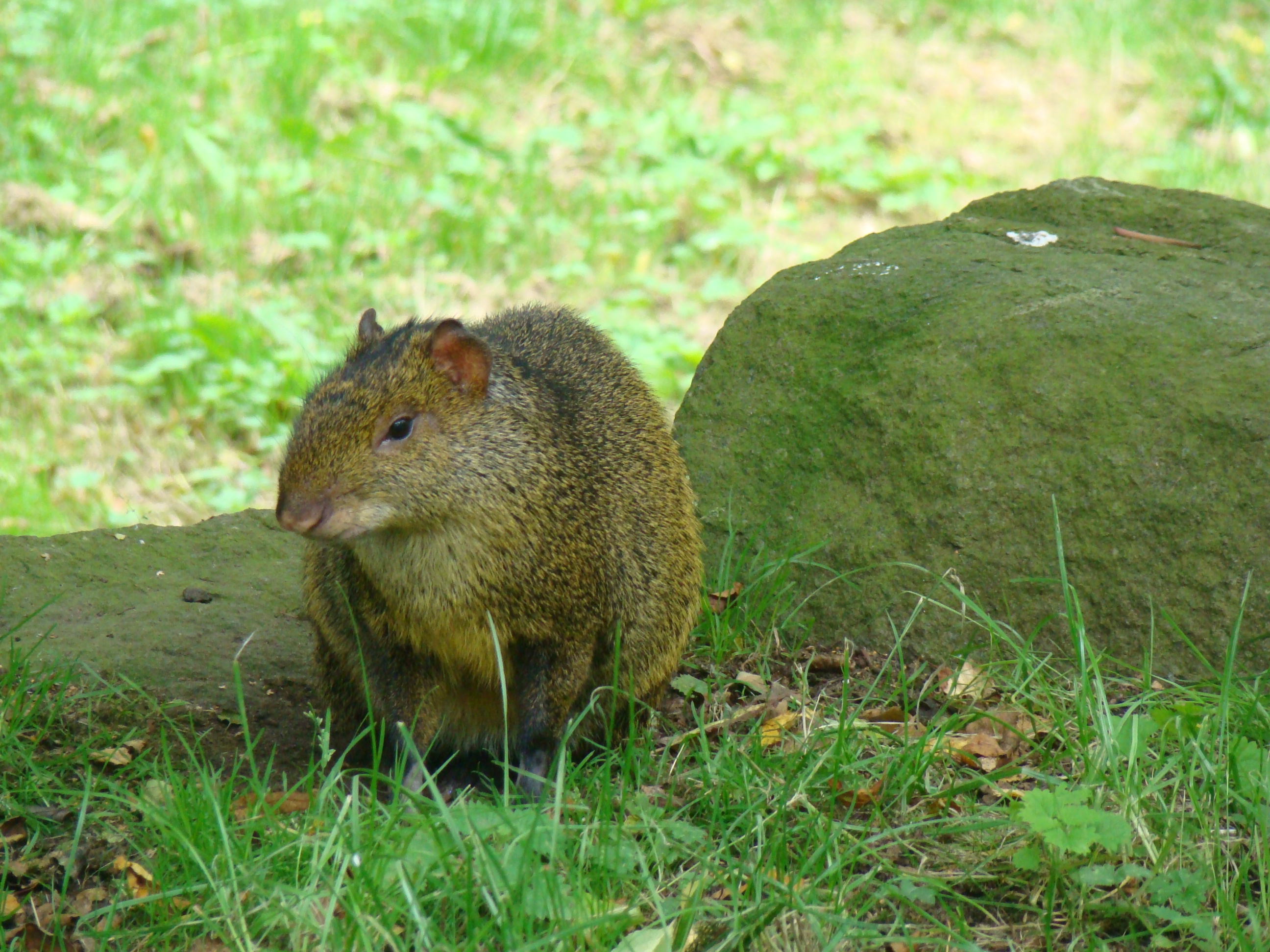
Agoutis can now be found in Tijuca National Park thanks to Refauna. Image by Abujoy via Wikimedia Commons under (CC BY-SA 2.5).
The example of Refauna underlines a broader theme: restoring forests requires thinking beyond trees and considering the entire system. This became even clearer when speaking with Dr. Weverton Trindade, a Brazilian biologist at the Universidade Federal do Paraná.
Trindade described how restoration efforts can fail when local ecology is ignored: “I know stories of people who just spread seeds in a region, but the region was not suitable for those species. They rented a helicopter to spread seeds in a conservation unit, but the topography was not suitable. They spent a lot of money on the helicopter and the seeds, and they didn’t reach good results.”
Instead, ecological data can guide more effective restoration strategies: “We have a lot of different methods for restoration. If you know the species that can live there, you can choose a different method. For example, if the species depend on animals to disperse seeds, you can invest more time and effort to protect—and maybe reintroduce—those animal species to help the forest regenerate.”
Golden Lion Tamarin Reintroductions
The successful reintroduction of the Golden Lion Tamarin has been a 40-year endeavor that shows what is possible through science-based, collaborative conservation.
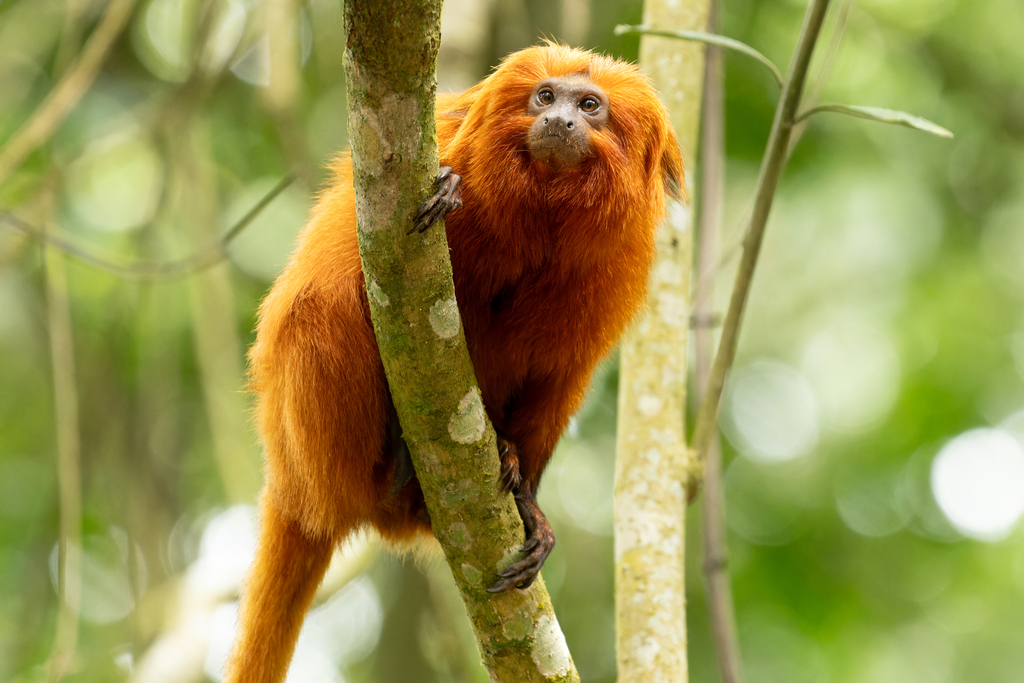
A Golden Lion Tamarin. Photo by Tomaz Nascimento de Melo under (CC BY-NC-ND).
Once numbering only a few hundred individuals in the 1970s, the wild population has recovered to approximately 4,800 tamarins today. The species conservation program has also contributed to the protection of over 12,000 hectares of Atlantic Forest under federal law. The book Behavior, Ecology, and Conservation of Golden Lion Tamarins by Andrew J. Baker and Benjamin B. Beck is a wonderful account of this historic conservation story.
I spoke with James Dietz, founding director of Save the Golden Lion Tamarin (SGLT). Dr. Dietz explained the significant impact species reintroduction has not only on forest restoration, but also human-forest connection: "Even though it's not a formal relationship, you're not gonna cut that forest because [the people restoring the forest] value those monkeys. And that is everything."
The golden lion tamarin became such a characteristic symbol of conservation that Brazil featured it on the 20 Real banknote.

By Rawlan1998 (Wikimedia Commons) under (CC BY-SA 4.0).
Dr. Dietz also explained why Golden Lion Tamarin conservation is essential even to people far removed from the forest.
For one, protecting tamarin habitat means conserving and restoring the Atlantic Forest, which directly supports climate mitigation. The protected area also safeguards critical watersheds and economic resources: "The forest that protects Golden Lion Tamarins protects a watershed that provides water to about a million people downhill, especially in beach communities. If we protect that forest, we protect that entire economy as well," says Dr. Dietz.
Moreover, the species serves as a conservationist's umbrella species. Protecting it safeguards far more than a single monkey: "When you conserve Golden Lion Tamarins, you're not just conserving one or two viable populations of a small monkey. You're conserving huge numbers of endemic species—plants and animals at all taxonomic levels. Many we know are endangered, and many more we haven't even studied yet."
In that sense, the reintroduction of Golden Lion Tamarins is more than a single monkey species—it is a connector between people, animals, and the planet.
"The forest that protects Golden Lion Tamarins protects a watershed that provides water to about a million people downhill. If we protect that forest, we protect that entire economy as well."
Where to Get Enough Land?
Yet, even though the will and urgency are there, the question becomes how to get enough land?
I spoke with Professor Pedro Brancalion, a farmer and prominent climate scientist at the University of São Paulo. "That's the hard truth about restoration. The main limiting factor for restoration is land. And an inconvenient truth is that there is no available land restoration. All lands have some use."
Land is income. And when deciding between feeding your family and abstract biodiversity protection, the choice is crystal clear: "It's good for the collective, but bad for the individuals offering land for restoration. When you restore, that's your land. The farmer who owns the land will lose the income coming from it", says Professor Brancalion.
Moreover, land restoration is a long-term decision. Once you decide to restore, that land is locked in for decades. Therefore, it is less flexible than agriculture.
"Restoration is different than agriculture. You cannot change land use after some time. It's a once in your life decision to be a successful restoration."
Traditionally, the value of ecosystem services has been taken for granted. Therefore, it can often be economically challenging to prioritize restoration over development. One way to incentivise restoration is through Payment for Ecosystem Services (PES). In this scheme, farmers are paid not to develop their land, hopefully providing a win-win for the individual and the collective.
The Tropical Forests Forever Fund (TFFF) was launched at COP30 in November 2025. This initiative has already received pledges of millions of USD to incentivize the maintenance of tropical forests.
But in the end, if you are serious about wanting to restore our forests, Professor Brancalion offers the most straightforward option: get your own land: "So how do you help conserve tropical forests? Buy some land and do it. Do your part in restoring the Earth. Don't expect that someone will do it for you."
"So how do you help conserve tropical forests? Buy some land and do it. Do your part in restoring the Earth. Don't expect that someone will do it for you."
Conserving the Atlantic Forest is Possible
When I asked Diego Igawa Martinez, project analyst at SOS Mata Atlântica, what it's like to see Atlantic Forest restoration be successful, he lit up.
"The restoration of the Atlantic Forest is possible. And every person who comes to us and visits, they are like mind blown off. Wow. That's what you can do. That's what getting back a forest to its natural state looks like. We are now recording more than 200 species of birds. Lots of species of mammals are coming back because of the resources that are in the forest, so we are trying to build these successful stories throughout all the biomes. And throughout those numbers, we have met so many wonderful people. So yeah, in the end, it's a really satisfying job. And I must admit that I'm pretty happy about working in this mission of trying to conserve and restore the Atlantic Forest."
"The restoration of the Atlantic Forest is possible. [...] I must admit that I'm pretty happy about working in this mission of trying to conserve and restore the Atlantic Forest."
There are people all over Brazil—and increasingly around the world—working persistently to restore what was once thought lost. The restoration and conservation of the Atlantic Forest are not only possible—they are happening right now.
Conclusion
It has been an incredible and enlightening journey to begin exploring the Atlantic Forest. This forest was once invisible to me, but now it means so much to me.
I'm still learning and exploring ways to contribute to the conservation and restoration of the Atlantic Forest.
What I love the most about this journey is all the people I've had the honor of meeting, talking with, and working together with. Thank you all!
References
At Climate Summit, Lula Highlights that COP30 Proposes a Pact for the Life of Forests, Oceans, and Humanity. (n.d.). Retrieved December 12, 2025, from https://cop30.br/en/news-about-cop30/at-climate-summit-lula-highlights-that-cop30-proposes-a-pact-for-the-life-of-forests-oceans-and-humanity
Baker, A. J. and B. B. Beck. 2023. Behavior, Ecology, and Conservation of Golden Lion Tamarins. Berlin, MD, USA, Salt Water Media.
Golden lion tamarin. (2025). In Wikipedia. https://en.wikipedia.org/w/index.php?title=Golden_lion_tamarin&oldid=1322465714
How Indigenous People Are Restoring Brazil’s Atlantic Forest. (n.d.). Yale E360. Retrieved December 12, 2025, from https://e360.yale.edu/features/brazil-atlantic-forest-indigenous-land-bees
MapBiomas Brasil. (n.d.-a). Retrieved December 12, 2025, from https://brasil.mapbiomas.org/en/metodo_cobertura_e_uso/
MapBiomas Brasil. (n.d.-c). Retrieved December 12, 2025, from https://brasil.mapbiomas.org/en/artigos-mapbiomas/
Over USD 5.5 billion Announced for Tropical Forest Forever Facility as 53 Countries Endorse the Historic TFFF
Launch Declaration. (n.d.). Retrieved December 12, 2025, from https://cop30.br/en/news-about-cop30/over-usd-5-5-billion-announced-for-tropical-forest-forever-facility-as-53-countries-endorse-the-historic-tfff-launch-declaration
Prete, G. (2025, September 10). How Forest Restoration Can Help Us Combat Climate Change. Retrieved January 8, 2026, from Earth.org website: https://earth.org/nature-based-solutions-restoring-forests-to-combat-climate-change/
Refauna – Filling empty forests with life. (n.d.). Retrieved December 12, 2025, from https://refauna.org.br/
Re.green – We’re doing it. (n.d.). Retrieved December 12, 2025, from https://re.green/en/
re.green—The Earthshot Prize 2025 Finalist. (n.d.). The Earthshot Prize. Retrieved December 12, 2025, from https://earthshotprize.org/winners-finalists/re-green/
Toto, R., Alix-García, J., Sims, K. R. E., Coutinho, B., Brenes, C. M., Pugliese, L., & Mendes, A. F. (2025). Evidence on scaling forest restoration from the Atlantic Forest Restoration Pact in Brazil. Nature Communications, 16(1), 4715–4715. https://doi.org/10.1038/s41467-025-59194-3