The Atlantic Forest
What does it take to conserve a forest?
Did you know that Brazil is named after a tree?
Brazil, short for "Terra do Brasil," means the land of brazilwood. For centuries, exporting its red dye and quality timber made Brazil a coveted monopoly. But here's the catch. You won't find the tree that gave Brazil its name in the Amazon.
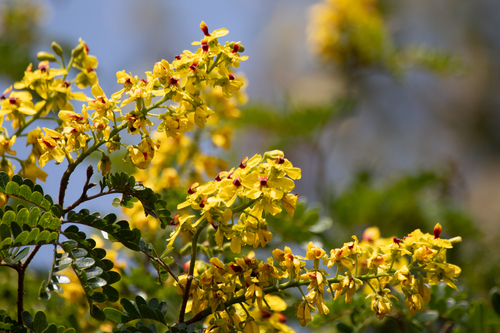
This now endangered tree, paubrasila, can only be found in the Atlantic Forest.
In fact, 70% of Brazilians live in the Atlantic Forest. It covers the entire east coast of Brazil, including the megacities São Paulo and Rio de Janeiro. But the Atlantic Forest is not widely known outside of Brazil.
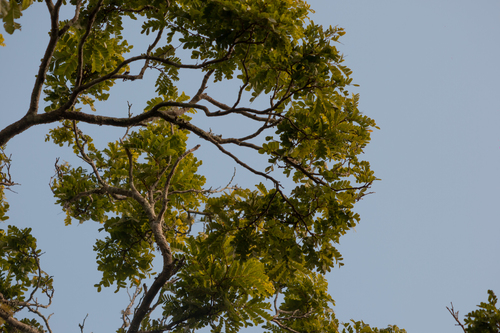
(Left): The paubrasila tree. Diego Monsores under CC BY-NC.
(Right): Flowers of the paubrasila tree. Henrique Bitencourt under CC BY-SA
This may be one reason why its destruction has gone largely unchecked. What was once covered in 330 million acres (equivalent to the size of three Swedens) today covers only 15%.
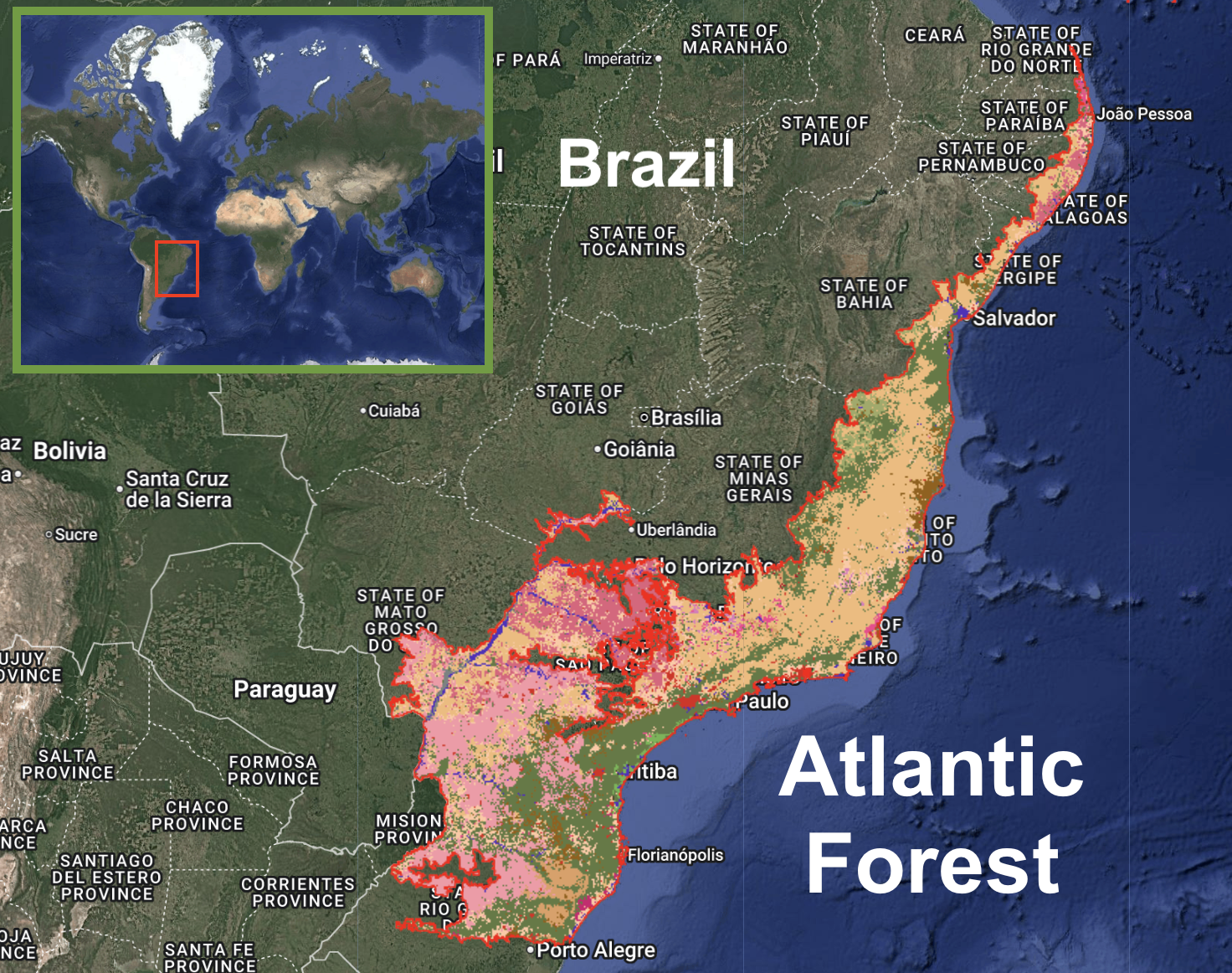
The Atlantic Forest Biome. The green spots represent the fragmented forest that remains as of 2024. From the MapBiomas Google Earth Engine Toolkit
Yet, it is still one of the world's most important hotspots for life. It contains over 20,000 species of plants, and 2,000 species of vertebrate animals, many of which you find nowhere else on the planet. And it provides services such as clean water and air to about 150 million Brazilians.
Listen to the podcast episode, The Invisible Forest? Protecting the Brazilian Atlantic Forest, containing interviews with some of the people featured in this article series.
Not long ago, I had not heard about this forest either.
I grew up in Sweden. I remember spending weekends deep in the forest, breathing in the scent of damp moss and fresh pine. However, when I started studying Computer Science at Stanford University, I felt more disconnected from the natural world than ever before. Having witnessed the extractive nature of the tech industry first-hand, I began to question whether software engineering could play a part in building a more sustainable future. Could it ever have a net positive impact on society?
So I became obsessed with the idea of using technology not to distance us from nature, but to better understand it. To not only restore what we lost, but also protect what's left.
That's why I joined The Natural Capital Project. This global, interdisciplinary center drives research and tools for green growth and nature-based solutions. Working with an incredible team, I've explored the wonders and complexities of the Atlantic Forest while developing data tools to prioritize reforestation.
And there was one question I couldn't shake: what does it take conserve a forest?
This five-part article series is a brief introduction to the many wonders of the Atlantic forest. And a brief account of the many conversations and readings that I've taken part in. And looking at how technology intersects everything from
- What is the Atlantic Forest, and why do we need to conserve it?
- How do we track, understand, and prevent deforestation?
- How do we preserve the unique and life-critical biodiversity?
- How do we quantify and optimize for ecosystem services?
- How do we restore what has been lost?
Throughout this journey, we will see some of the actual interdisciplinary work among indigenous communities, scientists, conservation organizations, legal professionals, governments, students, teachers, and organizers; a truly global pursuit among people, animals, and nature.
The Atlantic Forest biome extent
Why the Atlantic Forest?
Climate Stability
In spring 2024, the Brazilian state of Rio Grande do Sul experienced the country's worst flooding in over 80 years.
The floods left over 500,000 people displaced, without power or clean water, caused 181 fatalities, and resulted in US$3.7 billion in losses and damage.
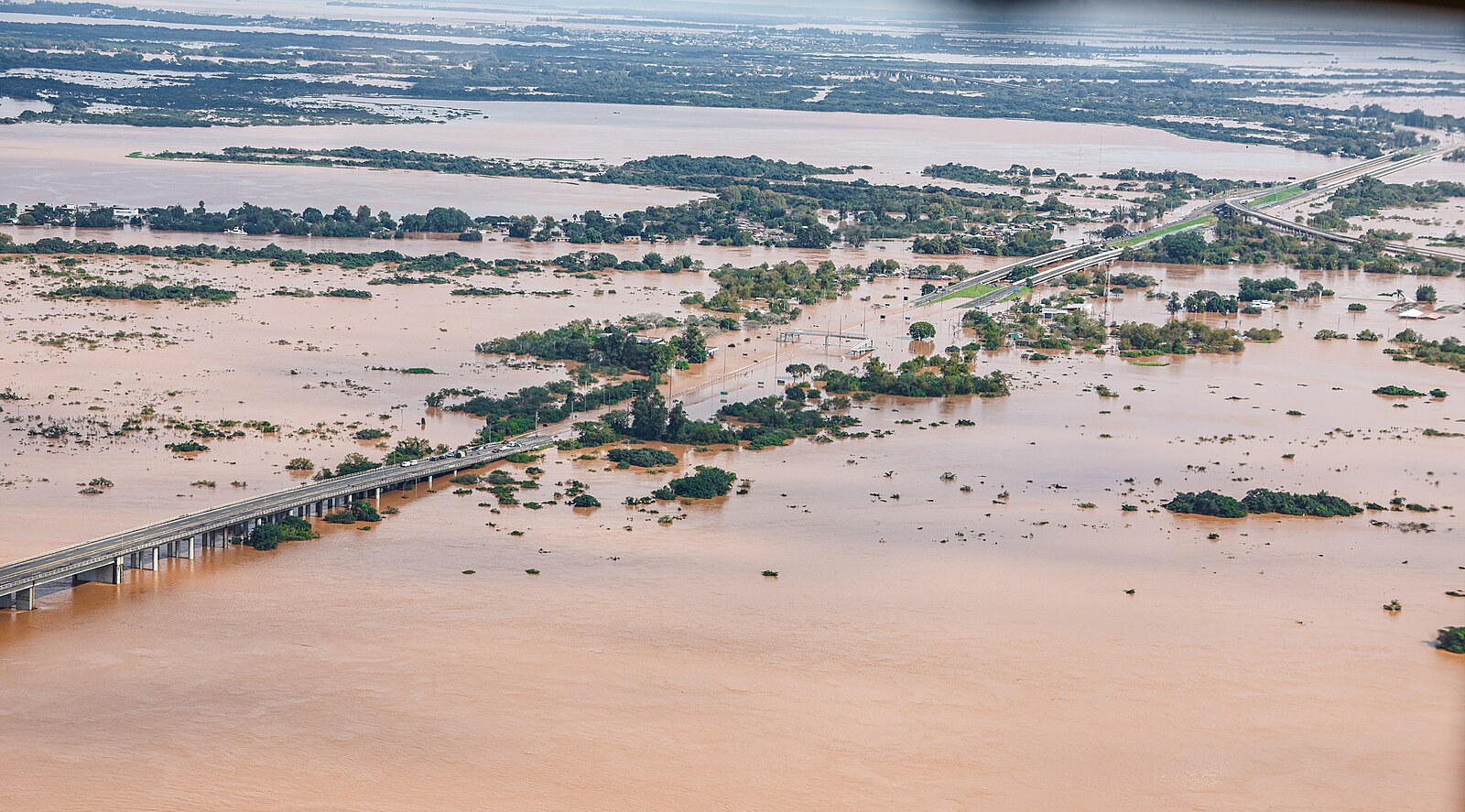
Flooding of Guaíba Bridge on 5 May 2024. Ricardo Stuckert under CC BY-SA 2.0

This is just one example of the more frequent extreme weather events in Brazil due to a changing climate. The dry seasons are becoming drier, and rainy seasons are bringing more intense rainfall.
One major driver of these extremes is the loss of large forest areas. Forests act as natural climate stabilizers, shaping rainfall, temperature, and water availability.
Tree canopies slow and soften rainfall, preventing water from hitting the ground at once and reducing the risk of flooding. Their roots pull water deep into the soil, storing it during storms and releasing it gradually during dry periods. These roots also anchor the land, lowering the risk of landslides.
Forests regulate the broader climate through evapotranspiration—trees releasing water vapor as they “breathe.” This process forms clouds, drives rainfall, and cools the surface. With fewer forests, less moisture enters the atmosphere, often resulting in hotter temperatures and less rainfall. Mature forests also act as powerful carbon sinks, storing carbon in their trunks, roots, and soils and helping slow global warming.
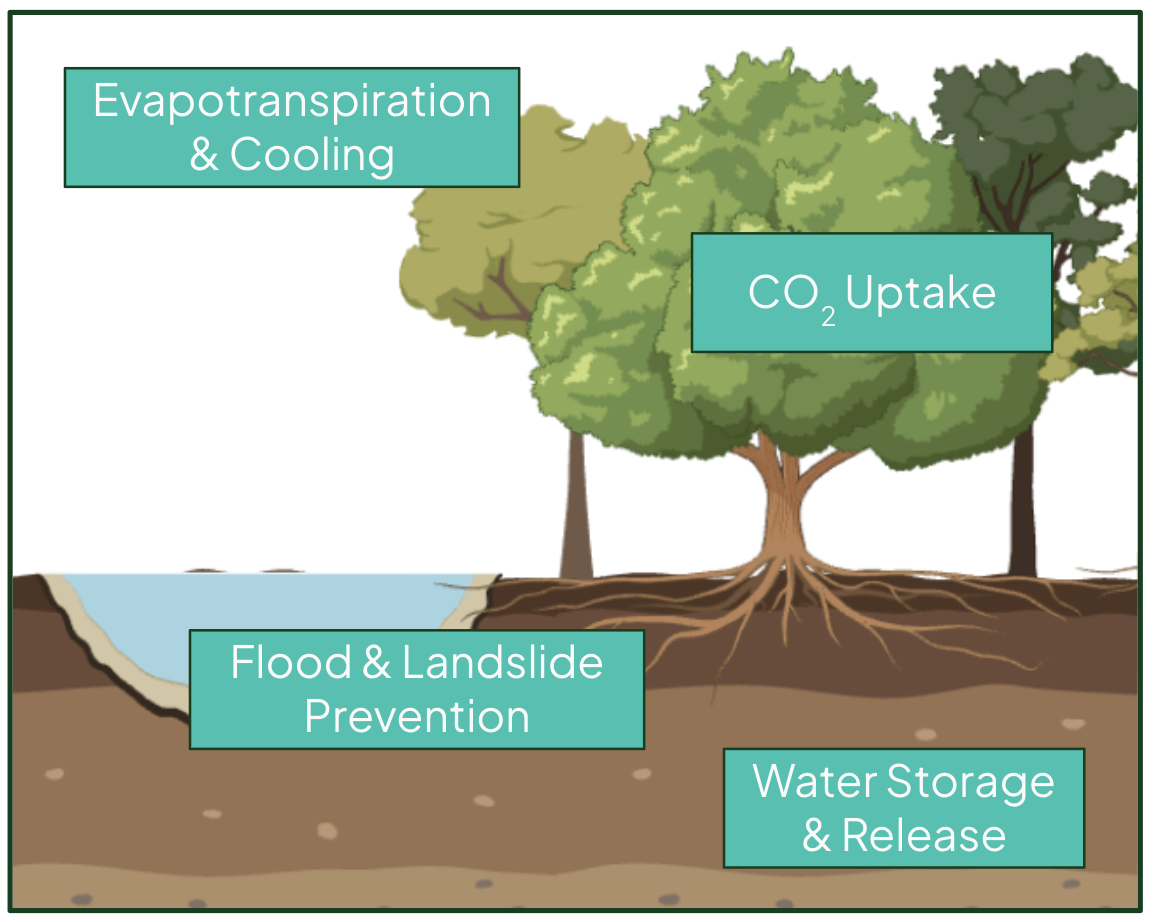
A few of the many ways forests contribute to climate stability. Image by the author using Biorender.
In short, the Atlantic Forest is essential for both local and global climate stability—and for protecting millions of people from worsening climate impacts.
Biodiversity
Despite being only around 12% of its original size, the Atlantic Forest supports an incredible diversity of species, making it a critical biodiversity hotspot.
This is one reason the United Nations (UN) designated the Atlantic Forest and its conservation efforts as a World Restoration Flagship within the UN Decade on Ecosystem Restoration (2021-2030).
It may seem as though biodiversity is a "nice-to-have "—sure, it's sad we lose some cute animals, but don't we have bigger issues to tackle?
That couldn't be farther from the truth.
Biodiversity is critical to ecosystems and human survival. Over 50% of modern medicines are derived from natural sources, including life-saving antibiotics and painkillers. According to the World Health Organization (WHO), over 75% of emerging infectious diseases arise in areas with disrupted ecosystems from deforestation or land-use change. Beyond medicine, biodiversity is essential for food supply and forest health. 70-90% of tropical forests depend on animals to disperse their seeds, and more than 75% of global food crops rely on pollinators. Brazil's significant agricultural exports, such as coffee and sugar cane, thus depend on biodiverse ecosystems.
Without animals, plants, and biodiversity, humans would face food shortages, water scarcity, and increased disease outbreaks.
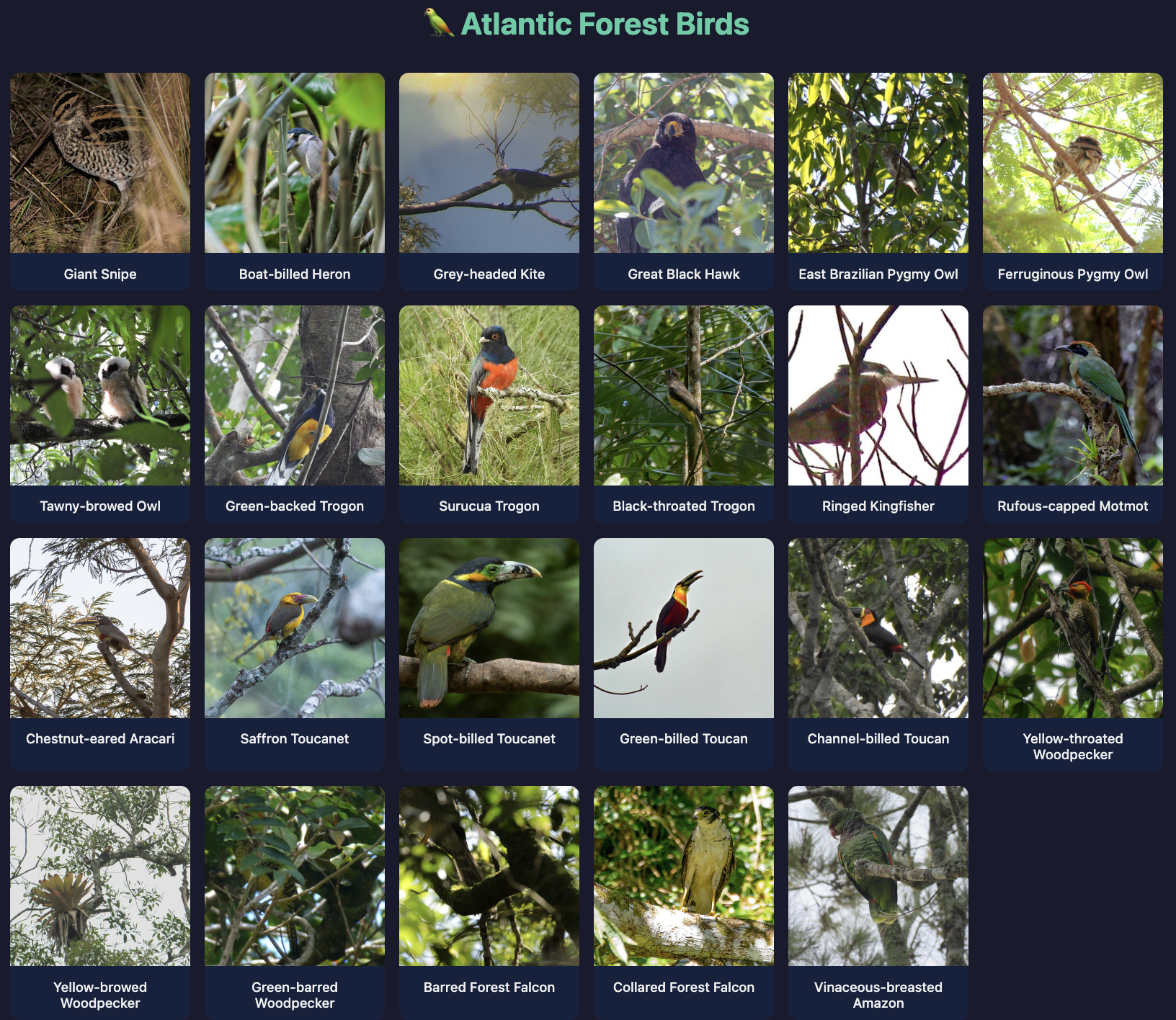
A sample of birds from the Atlantic Forest. Explore their sounds in this demo.
Water
I did not first realize the intricate connection between forests and water supply.
Trees act as biophysical barriers, filtering toxins and excess compounds before they enter waterways. Moreover, forests form symbiotic relationships with bacteria and other organisms that break down harmful chemicals, preventing water contamination.
In fact, the Atlantic Forest supplies clean water to 60% of Brazil's population—approximately 145 million people. Many of Brazil's hydrographic basins are located within the Atlantic Forest. However, many of these basins have low forest cover which affects water production.
What is more, hydropower generated in the Atlantic Forest provides 62% of Brazil's, 75% of Paraguay's, and 60% of Argentina's electricity. Once precipitation patterns change due to deforestation, this not only threatens water stability but also the national electricity supply.
In short, trees provide so much more than just timber for export.
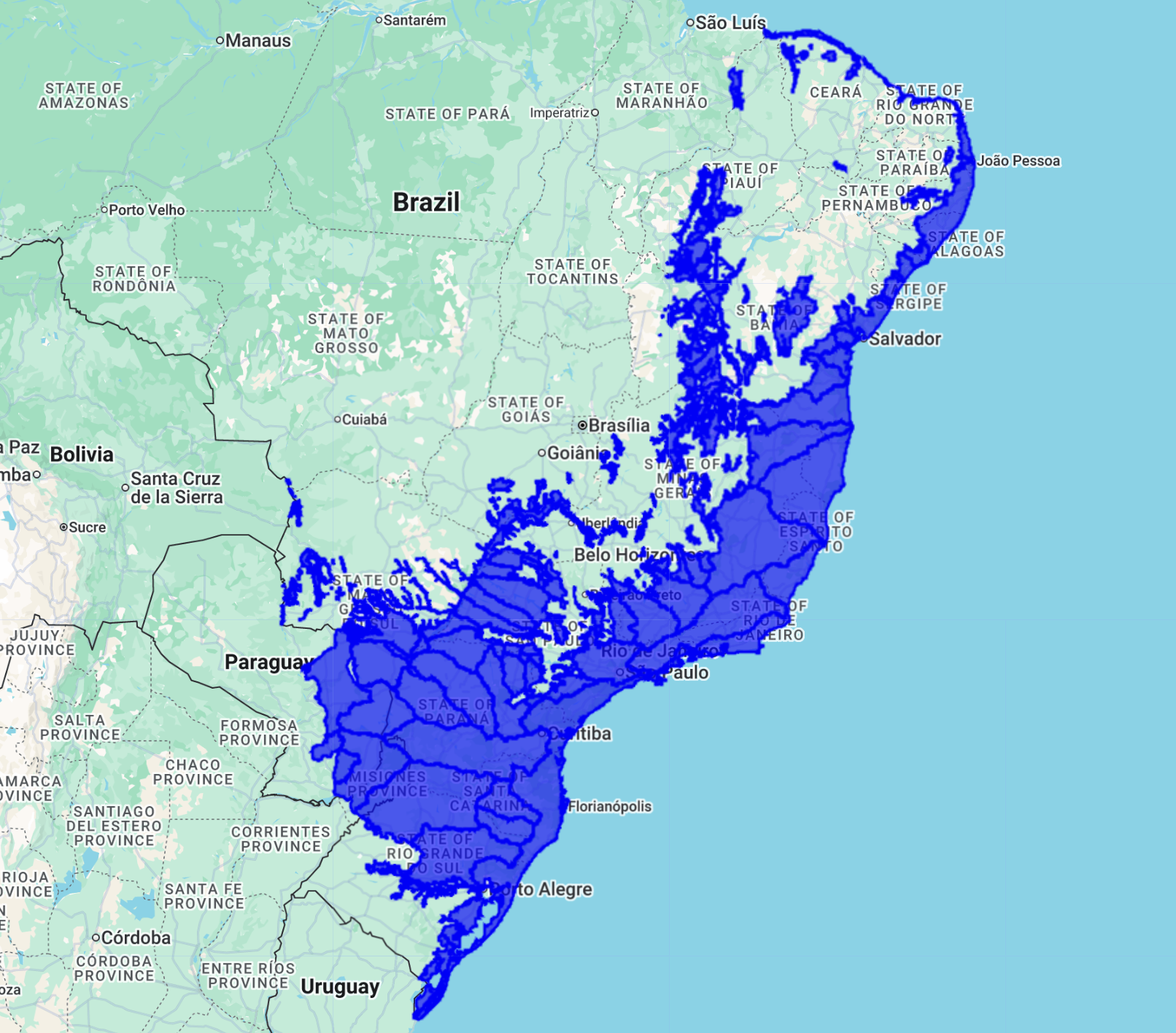
Water basins of the Atlantic Forest. Data: HydroSHEDS/HydroBASINS (WWF, 2022); Atlantic Forest extent from MapBiomas Atlantic Forest Collection 2.
Why Not Just Plant A Billion Trees and be Done?
So the natural question I asked: why don't we plant a whole bunch of trees and call it done?
Well, it's not that simple.
"Wait, wait, wait — not in the grasslands," cautioned Sarah Skikne, Natural Climate Solutions Scientist at The Nature Conservancy California Chapter, when I interviewed her. "The grass is valuable. It sequesters carbon deep in the soil over very long time periods. It harbors its own species that are important." Not every ecosystem should become a forest. Grasslands, wetlands, and other habitats each play critical ecological roles — and there's often a reason trees haven't grown there before. "So there's a reason that forests exist where forests exist, and grasses exist where grasses exist," she added.
The Atlantic Forest presents a particularly complex challenge.
"It's important to remember that we have more than 500 tree species per hectare," explained Diego Igawa Martinez, project analyst at SOS Mata Atlântica. "Every one of them has their particular preferences for growing, where they are in the ecological succession process... It's really not easy to rebuild a forest."
Climate adaptation adds another layer of complexity.
As Skikne explained, "When we plant trees, we need to make sure that they can withstand the inevitable ongoing climate impacts... We need to be thinking out 50, 100 years. What is the climate this tree is going to face when it's an adult?" This means carefully selecting species that will thrive under future conditions.
Then there are people's livelihoods.
More than 70% of Brazil's population lives within the Atlantic Forest region, including numerous traditional and indigenous communities who depend on the land. Much of the Atlantic Forest is on private land. Restoration must therefore work with these communities, not against them. This sometimes means creating economic incentives for keeping trees in the ground, like the Tropical Forest Forever Facility (TFFF), announced at COP30, where countries and landowners can get paid for maintaining tropical forests.
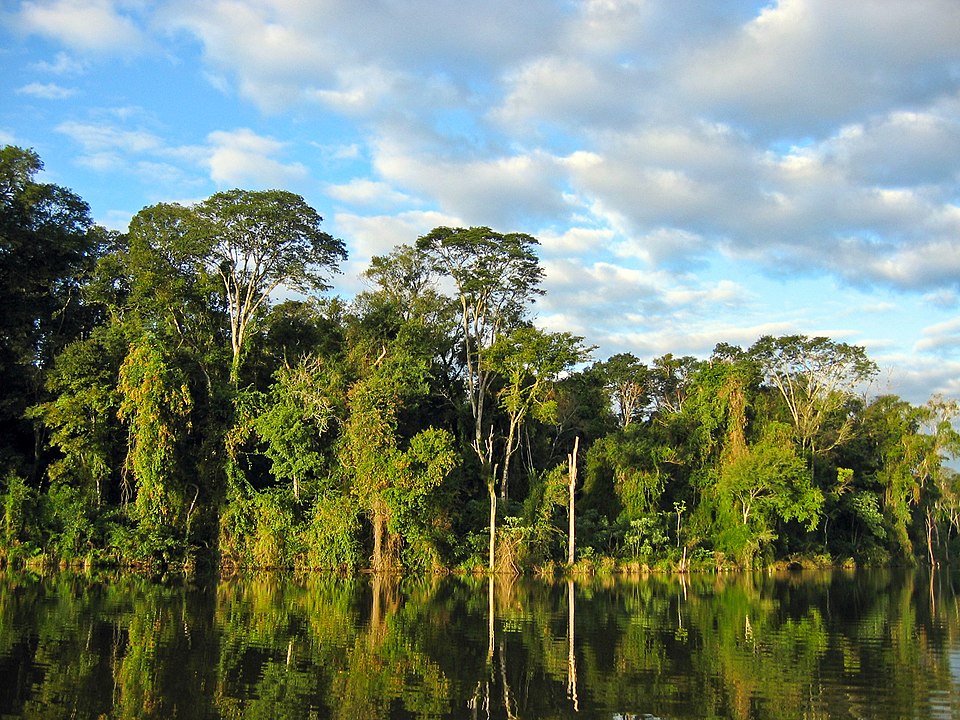
Atlantic Forest Illosuna on Wikimedia Commons under CC BY-SA 3.0.

Finally, as Skikne emphasized, "The much more important thing to do than planting more trees is to not cut down the trees we have. That's the most efficient, cost-effective way to conserve carbon. It's already there — you don't have to wait for it to get sucked back down."
This is where collective action becomes essential. The Atlantic Forest Restoration Pact (Pacto pela Restauração da Mata Atlântica), established in 2009, brings together more than 340 member organizations — NGOs, research centers, government agencies, and companies — to restore 15 million hectares by 2050. As Martinez shared, "We are now recording more than 200 species of birds, lots of species of mammals coming back... We are trying to show that restoration of the Atlantic Forest is possible."
And restoration is possible — but only if we protect what remains first, then expand thoughtfully from there.
"The much more important thing to do than planting more trees is to not cut down the trees we have. That's the most efficient, cost-effective way to conserve carbon."
People, Trees, Animals
It takes a holistic perspective — restore and protect, enhance biodiversity and support communities.
In the end, it's about people working with each other and the natural world. And somewhere in there, technology might help us get part of the way — supporting us in the pursuit of protection, helping us realize what's left to do, and holding ourselves accountable.
What you realize is that the Atlantic Forest isn't invisible. It's right there — you just need to learn what to look for. And remain curious about your surroundings.
What other invisible forests do you have around you?
Explore the Full Series
References
2024 Rio Grande do Sul floods. (2025). In Wikipedia. https://en.wikipedia.org/w/index.php?title=2024_Rio_Grande_do_Sul_floods&oldid=1319968733 assumed, N. machine-readable author provided I. (2004).
Altantic Forest in Paraguay. [Graphic]. No machine-readable source provided. Own work assumed (based on copyright claims). https://commons.wikimedia.org/wiki/File:Atlantic_Forest.jpg
Atlantic Forest declared UN World Restoration Flagship. (2022, December 14). World Wildlife Fund. https://www.worldwildlife.org/news/stories/atlantic-forest-declared-un-world-restoration-flagship/
Atlantic forest: The most threatened biome in Brazil. (n.d.). Neoenergia. Retrieved November 29, 2025, from https://www.neoenergia.com/w/mata-atlantica-o-bioma-mais-ameacado-do-brasil
Bello, C., Crowther, T. W., Ramos, D. L., Morán-López, T., Pizo, M. A., & Dent, D. H. (2024). Frugivores enhance potential carbon recovery in fragmented landscapes. Nature Climate Change, 14(6), 636-643. https://doi.org/10.1038/s41558-024-01989-1
Biodiversity. (n.d.). Retrieved November 29, 2025, from https://www.who.int/news-room/fact-sheets/detail/biodiversity
Brazil floods: Hundreds of Rio Grande do Sul towns under water. (2024, May 7). https://www.bbc.com/news/world-latin-america-68968987
MapBiomas Brazil. (n.d.). Retrieved November 29, 2025, from https://brasil.mapbiomas.org/en/2021/09/15/mata-atlantica-o-desafio-de-zerar-o-desmatamento-no-bioma-onde-vivem-mais-de-70-da-populacao-brasileira/
Medicinal Botany. (n.d.). Retrieved November 29, 2025, from https://www.fs.usda.gov/wildflowers/ethnobotany/medicinal/index.shtml
Natural Capital Project. (n.d.). Retrieved November 28, 2025, from https://naturalcapitalproject.stanford.edu/
O movimento—Pacto pela Restauração da Mata Atlântica. (n.d.). Retrieved November 29, 2025, from https://www.pactomataatlantica.org.br/o-movimento/
Paubrasilia. (2025). In Wikipedia. https://en.wikipedia.org/w/index.php?title=Paubrasilia&oldid=1314655450
Seymour, F., Wolosin, M., & Gray, E. (2022). Policies Underestimate Forests’ Full Effect on the Climate. Retrieved January 5, 2026, from World Resources Institute website: https://www.wri.org/insights/how-forests-affect-climate
The Atlantic Forest. (n.d.). World Wildlife Fund. Retrieved November 29, 2025, from https://www.worldwildlife.org/places/atlantic-forest/
Trinational Atlantic Forest Pact. (n.d.). UN Decade on Restoration. Retrieved November 29, 2025, from http://www.decadeonrestoration.org/trinational-atlantic-forest-pact
Tropical forests can’t recover naturally without fruit eating birds. (2024, April 15). ETH Zurich. https://ethz.ch/en/news-and-events/eth-news/news/2024/04/tropical-forests-cant-recover-naturally-without-fruit-eating-birds.html
UN Decade on Restoration. (n.d.-b). UN Decade on Restoration. Retrieved November 29, 2025, from http://www.decadeonrestoration.org
What is the Atlantic Forest? (2025, September 23). World Wildlife Fund. https://www.worldwildlife.org/news/stories/what-is-the-atlantic-forest-and-why-do-we-need-to-save-it/
What to know about the Tropical Forest Forever Facility from COP30 | Project Drawdown®. (2025, November 26). https://drawdown.org/insights/what-to-know-about-the-tropical-forest-forever-facility-from-cop30